February 09, 2014
2013 Fuel Annual Report Says I Was Lazy

Click the image to view my 2013 Nike Fuel Annual Report full size.
Appified things, smart stuff or service avatars (whatever you would like to call them) like Nike Fuelband are making the world, and our behavior in it, more "real" than ever before. Although they take form as a digital overlay, their (ever) presence can in some ways give us a more "true" reflection of our behavior than our memories or biases could otherwise accept. I recently downloaded my own 2013 Fuel Annual Report–a lovely data visualization of my last year of activity–and had two immediate reactions: disappointment and defensiveness.
I was disappointed because although 2013 was a more active year for me than 2012, it was a hard reality to accept that I had exactly 1% (10 min) of exercise per day and only .6 workouts per week. Numbers like that make it difficult to believe you're healthy. On the other hand, I was defensive because my Fuel report didn't accurately reflect all of my activity. Sometime my Fuelband was out of juice, sometimes I forgot to wear it, and other times, it flew off my wrist as I played basketball. The annual report measured what it could when it had power and when it was on my wrist. But what about all of those other times?
We can reasonably assume that as we jump forward five or so years, we'll have access to wearable computing devices that are both more comfortable and less intrusive, especially in the fitness and health spaces. As others have noted, we’re moving to an era of everything that can be measured being measured. Health is an obvious focus but each aspect of our lives will ultimately be introduced to this type of constant measurement and feedback loop.
Are we ready to face our own behavior as brazenly as Fuelband or a Withings Scale will reflect? The founders of the Quantified Self movement were a reflective bunch, really focused on trying to understand themselves and their impact on the world. Are we all ready to have this (sometimes harsh) reflection? A related aspect of QS is the assumed recommendation and decision-making support it affords. If our children grow up in a world where every decision they make is based in some way on the recommendation of an algorithm, how do we teach them to make good decisions and judgements independently?
These are important questions. They are big questions. We have yet to answer them.
If you use Nike+, you can get your 2013 Annual Report here: Posted by zacharyparadis at 10:18 PM
The SoDA Report 2013 Volume 2
Early last year, I edited the the “People Power” section in Volume 1 of the 2013 SoDA Report. Both the report and my section turned out really well, being downloaded over 150,000 times. A personal highlight is an insightful interview I did with Patrick Whitney, Director of the Institute of Design. You can download Volume 1 of the report as an interactive iPad app or go grab it here on SlideShare: 2013 SoDA Report Volume 1.
Although I edited the "Tech Talk" section of Volume 2 last year, I never got around to posting it here. That's a shame given it's a great report which was also very successful, and downloaded over 90,000 times. The intent of the Tech Talk is to "future gaze on the technology developments and trends impacting the industry." Given the larger context of our world, just about everything we do is either being directly delivered or enabled by technology. This fact is more remarkable given the great majority of designers or marketers likely never got into the business out of a love of technology. Ironically, today we can't be successful without it.
There is a lot of great thinking in the report and the interview I did with Mike Kuniavsky, author of Smart Things and Principal at PARC Innovation Services Group, is worth a read. He shares his thoughts on the question: "If you had to select three technologies set to change people's lives, what would they be?" You'll have to check out the report to find out. Grab the interactive iPad version or, view it on SlideShare:
One final note: Volume 1 of the 2014 SoDA Report is out imminently! Look for it.
Posted by zacharyparadis at
08:18 PM
Teaching and Writing on Experience Modeling
The design and UX community talks breathlessly about “customer experience” but, in the end, tends to focus more on the details of web, mobile or product design than “customers” or “experience” itself. As I and others have pointed out, an “experience” is not possible to design. With that, I have made a concerted effort to highlight what can be designed (touch points, products, services and systems which power them) and how data from individual customer experiences can be aggregated into valuable experience models in inform design.
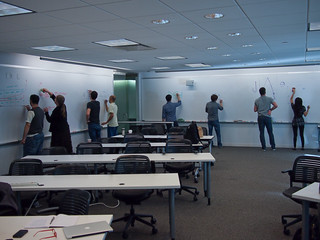
Picture: Rapid Experience Modeling Fall 2011 Intercession
I am working hard to push this thinking forward in two ways. First, I’m teaching a class at the IIT Institute of Design on the topic. It is an expanded version of an earlier course (Rapid Experience Modeling) which I have taught a couple of times previously. Earlier incarnations had always seemed rushed in 7 week session, or 5 day intercession, formats. This will be a full 12 week course, enabling both myself and the students to dig deeper and resolve our thinking. Here’s the course description for Experience Modeling:
As the number of touch points with customers have exploded, the challenge in understanding and managing a multichannel customer experience has become increasingly problematic. IDN514 is an immersion course in “Experience Modeling”: the process of illustrating current and future experience for the purpose of design-led innovation. The focus of the course will be in quickly creating different experience models to describe the world, problems and opportunities–both heuristic and generative. Several models will be created each week on a particular “Aspect of the Experience”–people, journey, mode, value, and ecosystem–with heavy critique and discussion in class. Final presentations will consist of a completely integrated story illustrating a set of people, their experiences with an organization, resultant opportunities and a future state experience.
The primary course objective is to enable students to be comfortable in describing and illustrating multichannel “Experience”, illustrating insight from research and providing definition for strategy. More tangibly, the class is built around mastery of five core model types–the “Aspects of the Experience”–that work together to create a complete, compelling and actionable picture of people and their interactions with an organization.
The course itself also relates to the second way I am pushing thinking in Experience Modeling: my second book. I started the book earlier this year and it is coming (slowly) along. The books title at this point is Innovating Experience and sort of starts off where Naked Innovation ends. If
Naked Innovation is about all types of innovation (including internally focused facets like core processes), Innovating Experience is a deep dive on how to produce a higher hit rate specifically in customer experience. It’s exciting stuff and makes my return to the US and Chicago even more satisfying. Teaching and writing is easier in the confines of my longtime home, with a large support network of professional colleagues, academics and friends to help me through the dark days of book writing.
While I’ve thought through the structure and outline of the book, I only have three chapters drafted. It’s a 2014 release, for sure. More on that soon...
Posted by zacharyparadis at
01:20 PM
SoDA Report Volume 1
In Miami 2007, 13 leading digital agency CEOs decided to meet up and have a talk about where their industry was headed. New friends were made, business problems and solutions were shared, a society was formed. They were on a mission to advance an industry they all felt so passionate about. They made it official at SXSW in 2008: the Society of Digital Agencies (SoDA) was formed. Digital agencies now had a voice.1 My firm, SapientNitro was one of those founding members.
Since then, SoDA has grown significantly and evolved to be The Global Society for Digital Marketing Innovators (still SoDA for short). Their primary objectives are to share best practices, educate and advocate for digital agencies. Other parts of the design and marketing industries have groups aligned to them, so why not digital? It’s members are truly global, spanning both America’s, Europe and Asia.
One of the most significant activities SoDA conducts is producing the (now) twice annual SoDA Report: a research and trend publication, showcasing content from some of the most influential thinkers in the digital marketing world. Editor-in-Chief, Angèle Beausoleil describes Volume 1 of the report like this, “The 2013 SoDA Report reveals new perspectives, fresh ideas and real concepts of how organizations are balancing the art and science of perception to succeed in these fast-paced times.”
I was asked to edit a section of the report earlier this year. “People Power”, as the section was known, began focused primarily on education. The question it sought to explore is a pertinent one: “How should the marketers of the future be taught to effectively play their role in business and society?” How could we enable the people in marketing? As each piece was submitted, it also became clear that the section gained a larger meaning, uniquely related to its name: People Power. The authors all recognized a critical shift in the dynamic between marketers and consumers. It is a shift that is forcing the industry to reconsider its approach, its methods, and indeed, its philosophy.
The report turned out really well and my section includes a few highlights, including an interview with Patrick Whitney, Director of the Institute of Design. You can download Volume 1 of the report as an interactive iPad app or go grab it on Slideshare:
1 A bunch of that first paragraph was paraphrased and quoted from SoDA’s About page. Why reinvent the wheel?
Posted by zacharyparadis at
11:23 PM
Design Planning Before Design Process
I had an opportunity to talk at two great events at the end of 2012. Given my transatlantic move and transitioning into a new role at SapientNitro, I’ve only now come up for air to write about them.
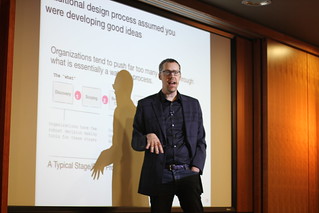
The first event, UCD2012, took place in London in November. Five of the UK’s most influential professional organizations teamed up to offer this unique User-Centered Design conference. UCD2012 explored how User Centered Design is applied in a variety of disciplines and contexts. The conference focused on leading UK based speakers (I was UK-based at the time). The Confederation of Indian Industry (CII) and India’s National Institute of Design (NID) organized the second event, the 12th annual CII-NID Design Summit. The 2012 summit featured some of the best Indian and international design thinkers, practitioners and design supporters exploring the theme of “Design Doing”.

I gave what was approximately the same talk at both events: Design Planning Before Design Process. Here is the abstract for the talk:
We all want to advance our practice in design and user experience. As different methods are introduced, our approaches evolve. In the product world, that meant singular mastery of shape and form evolved to ergonomics and human factors, which shifted to user-centered design then the design of “experiences”. In the digital world, web masters became web designers, splintering into visual design and information architecture, which was broadened to “experience design” and some people talking about “Lean UX”.
Simultaneously, product development and project management have evolved. A world once built entirely around waterfall processes, classical engineering and Six Sigma, shifted to more agile ones with labels like “Scrum” or “XP”. In Japan and elsewhere, manufacturing became “Lean” and, more recently, with the proselytization of Steve Blank’s thinking on customer development and the introduction of Eric Ries’ excellent book, everyone’s talking about how start-ups need to be “Lean”.
The approach one advocates typically depends on a number of factors: education, experience, the type of organization we work for, and the current blog being read. The reality is that what is most often advocated is either the most familiar or new. Each approach reaches a “New Black” status with a breathless set of fan(atic)s. Whether “New Black” fanatic or traditionalist, practitioners tend to propose a single approach–the notional hammer–regardless of the problem.
In fact, it is actually much more important to talk about approachesrelative to problems. Just as it would be madness to use a hammer for every physical building project, it would be equally so to use the same approach with every design or UX project. The talk refined content from the Evaluation chapter of my book, Naked Innovation, seeking to introduce a world where “Design Planning” precedes “Design Process” resulting in a portfolio of multiple approaches aligned to multiple problems.
Needless to say, this thinking will be introduced in the next version of Naked Innovation, to be completed in early 2014. Before then, I’ll try to get a version of the presentation up on Slideshare with an accompanying presentation audio track.
While I was in India, I also had the honor to be on the jury for the CII Design Excellence Awards 2013. While only the second year a major national design prize was awarded, it is clear India is getting serious about design. During the conference, it was quoted to me that ten years ago there was only a single design school in all of India, the well regarded National Institute of Design. Just a decade later, there are now over 40 schools. That there are only 40 schools in a country with more than 1.2 billion people is still pretty shocking. Nevertheless, we can be sure both the quantity and the quality of design will rapidly increase. Entries for these awards is a testament to that.
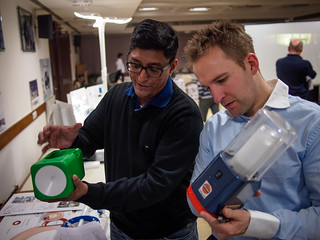
My personal favorite of the competition was the incredible ECCODiva multipurpose LED light and solar charger. Designed by Dipendra Baoni and his team at the multifaceted lemon design, the ECCODiva is a refined product which could easily look in place in the world of high design as well as in a small village with no power. Its strong looks are backed up by incredible ergonomics, usability and engineering which includes an embedded processor to extend its functionality. It is an incredible piece of design.
Here’s a picture of fellow jurists Abhijit Thosar and Paul Hendrikx evaluating the ECCODiva (on the left) and another competitor.
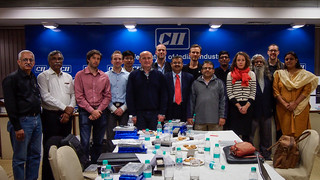
Of course one of the most excited things about judging awards is interacting with fellow jurists. I was lucky enough to interact with a rock star group of designers from India, Sri Lanka, Finland, the UK, the USA, the Netherlands and South Korea. It was a tremendous experience.
Posted by zacharyparadis at
04:50 PM

