projects | zachary jean paradis

Here are a few projects I can talk about publicly.
Latest Live Project Work
McLarenAutomotive.com and Multichannel Experience Strategy /
Born on the track 50 years ago, McLaren is a legendary racing team with more wins than any other in the last century. More recently, the McLaren Group determined to launch a proper car company. Introducing a luxury supercar brand in the 2010's required a customer experience to match the compelling, technology-enabled experience of the vehicles themselves. I led the pitch to win Digital Agency of Record and articulate a distinctively McLaren multichannel experience. This strategy outlined the brand experience and appropriate roles for the web, social channels and critical digital-enablers at both auto shows and in dealerships around the world. These expose the richness of the McLaren back story with compelling content, functionality to (for lucky ones) buy the ultimate supercar, and pave the path to connected cars.
Take a look at the new McLaren Automotive and also stories regarding its launch in Luxury Daily and GT Spirit. Also check out some of the user research and UX documentation by one of my team, UX lead Kalpesh Rathod.
M&S Multichannel Experience Strategy /
Founded in 1884, M&S (Marks and Spencer) is one of the most storied, well known and successful retail brands in the world. I worked for nearly a year outlining a multichannel experience strategy for one of the most challenging, and certainly the largest multichannel retail programs in the history of the world. With a full relaunch set for early 2014 across all digital touch points and key systems enabling store staff, the current M&S.com hints at what is to come: a customer experience driven by Everyday Inspiration.
Read an article reporting on the news of SapientNitro being named lead partner helping move M&S off Amazon here: M&S Appoints SapientNitro Developer of New Multichannel Platform.

Target.com Multichannel Commerce Platform Strategy /
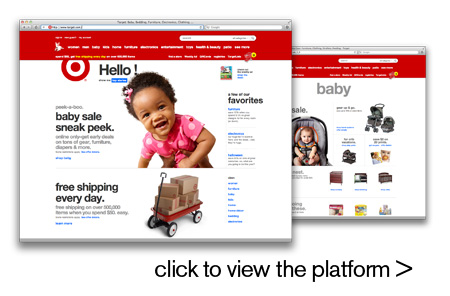
Over two years ago, the massively popular US retailer Target had a difficult choice: to continue using Amazon as its eCommerce platform or face the prospect of rebuilding it's entire $1.2B annual digital business from the ground up. Leading both the the proposal to win our initial relationship with Target and acting as strategist and engagement lead for the first three phases to achieve this feat was the hardest, most complex work in my life. Ultimately, I led the crafting of an overall vision, the benefits case which went to the board, the roadmap to build out a multichannel customer experience platform, and the successful scaling of people across nearly 20 global partners to deliver successfully by August 2011.
SapientNitro, lead partner; HUGE, concept design; other partners.
John Deere Global Internet Vision & Strategy /
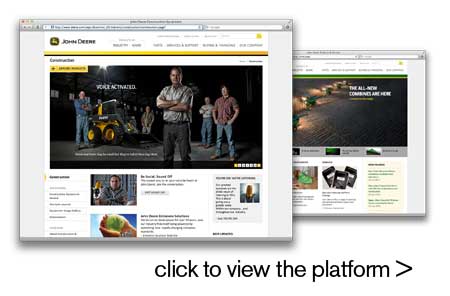
Three years ago, John Deere looked across its global operations and realized their use of connected technologies was not was it needed to be. Leading a 17 week Global Internet Vision and Strategy, my team spanned the globe understanding customers in agriculture, construction, forestry, commercial and consumer lawn care. We assessed a complex web of over 400 John Deere applications and a slew of hardware delivering customer experiences. The strategy and concepts were signed off by the C-suite and put into practice where it is now in the midst of delivering on a multi-phase, multi-year roadmap to deliver information, transation and business solutions to customers all around the globe.
The new JohnDeere.com is just one of the touchpoints being addressed, helping scale information about their company, products and services far further than their strong dealer network could ever realize.
Moto WNDR /
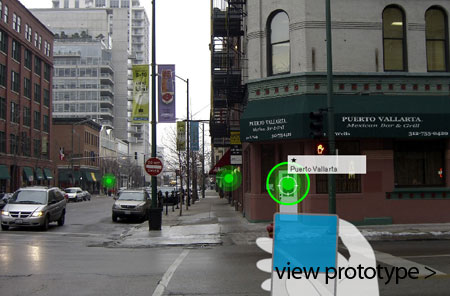
Google Glass anyone? Created in the Fall of 2006, WNDR predated augmented reality platforms like LAYAR and Yelp's Monocle. As I wrote back in 2007, “Virtual Reality” is set to be unleashed far from traditional desktop computing environments. Over the next decade, trends in truly ubiquitous broadband, mobile computing power (think laptop power in a mobile phone/iPod sized device), and retinal imaging will radically reshape how we interact with the world. WNDR envisions this future by imagining an overlay of relevant information directly in one's point of view. It is as if we could reach out and touch information related to our environment and change “channels” to any particular type we need.
Download a partial presentation deck (14MB) and also check out the flash prototype. My teammates were Lauren Schwendiman (now working at Motorola) and Gabe Biller (responsible for flash prototype programming).
MindshareViz /
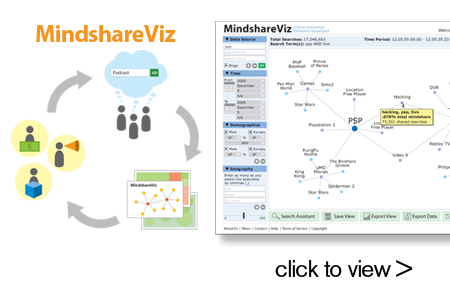
Imagined in Fall of 2005, for marketers, product developers and venture capitalists who are dissatisfied with traditional trend forecasting and market research reports, MindshareViz is a real-time trend visualization tool that reveals consumer intent through online search behavior.
By visualizing real consumer's online search and thoughts behavior, MindshareViz allows value creators a window into the collective population's desires. If you would like to view the entire, fully audio-annotated presentation contact me for a link to download. Otherwise, download the short summary: MindshareViz Teaser (1MB).
*Update* Google ended up building a remarkably similar tool to MindshareViz called Google Trends. It uses some of the features highlighted in MindshareViz in limited ways yet focuses mainly on a stock market like view. Check it out: Google Trends.
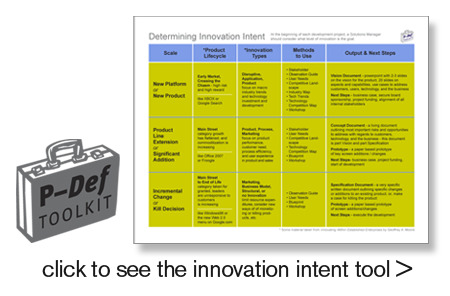
PDEF Toolkit /
Developed in a Planning Workshop at the ID in the Fall of 2006, the PDEF Toolkit is an integrated suite of research, analytic, collaboration, and generative tools for product definition. PDEF is built to empower and service untrained product managers in large organizations. Parts of the toolkit are currenty in use at enterprise software leader SAP.
This project was graciously funded by SAP and developed by a team led by myself, featuring Enric Gili Fort, David McGaw, Min Ouyang, and advised by ID Assistant Dean Jeremy Alexis.
The Many: Social Constructs
in World of Warcraft /
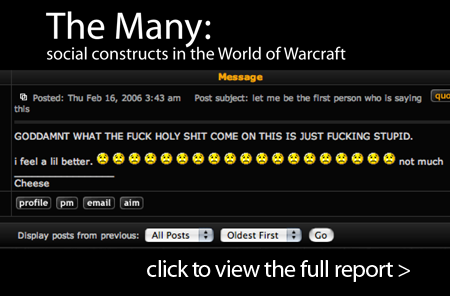
Virtual social networks have exploded on the internet. While the press generally cites facebook, MySpace, among other “normal” web applications, I had the pleasure (and pain) of experiencing the most immersive social network created by man thus far: Blizzard's massively multiplayer game World of Warcraft. I used methods from my social science training to study WOW in 2006 and try to make sense of the social constructs found within it. The project was too short at 7 weeks, traditional tools were woefully lacking in utility, and the group I was studying imploded in the midst of research. That said, the report (8MB) is still worth a gander.
Building Sustainable Enterprise: Beyond Awareness /
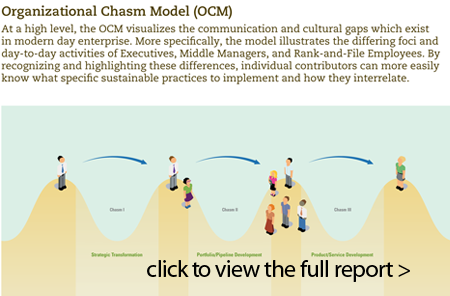
Design has been receiving a lot of blame and responsibility with regards to sustainable products and development. The thing is, “Design” hasn't really been in a position of power in the last century. This is all changing as society and companies have to reconcile with the externalities produced as a result of the Industrial Revolution and modern day corporations. We're working at a global scale and we're going to have to design not only ecologically friendly products but also Sustainable Enterprises. Check out this report.
I had the pleasure of working on large and diverse team led by Eric Wilmot. Check out the report for who else worked on the project.
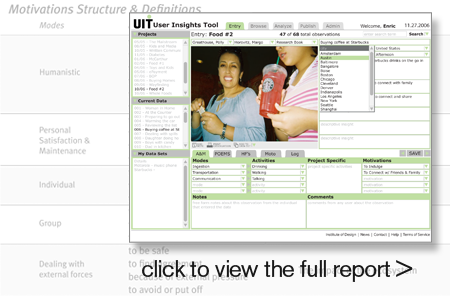
User Insights Tool /
Learning about people in their own context is, without a doubt, the easiest way to uncover unmet or unarticulated needs and opportunities. Unfortunately, data collected in user research is difficult to manage and turn into useful information for product teams. The User Insights Tool, imagined in Spring of 2007, seeks to demonstrate how a software based database for design research could turn discrete data into a scalable, re-usable, and actionable platform for user insights.
My teammates on this project for a graduate class in interaction design included Enric Gili Fort and John Kestner. We were advised and the UIT was invented by professor Vijay Kumar and ID's Director Patrick Whitney.
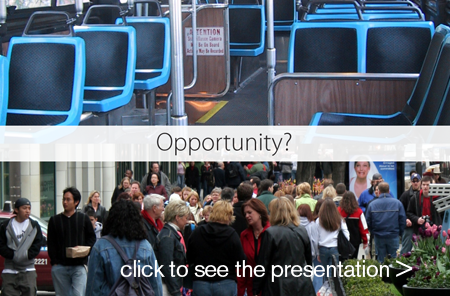
CTA Citybound /
Developed in a class on service design at the ID, CTA Citybound is a new service matching the Chicago Transportation Authority's excess weekend bus capacity with unmet needs of the many tourists to Chicago. More convenient, safer, less expensive, and faster than renting a car or using a taxi, Citybound offers a unique and holistic Chicago transportation experience.
Co-taught by McDonald's Vice President of Innovation, Denis Weil, and IDEO's service design guru, Mark Jones, the class offered a unique and valuable perspective on how to integrate a customer's experience beyond products. Download my team's presentation here here.
The New India /
India's growth presents tremendous risks and opportunities. The New India is a suite of strategic recommendations for Hindustan Lever Limited, the country's oldest and most successful consumer products company. Key to these recommendations is a two part plan to enable India's agricultural industry while connecting with the growing middle class consumer population in urban areas. Interestingly, several of the recommendations have been implemented successfully by other companies. Most namely, ITC's rollout of shopping at their e-Chupal locations.
This work was completed in Spring of 2006 with teammates Clinton Barth, Mark King, and Dan Greene in a Strategic Planning workshop taught by Vijay Kumar. Download the full report.

SAP Design Services Team /
The Summer of 2006, I spent in Silicon Valley working for enterprise software leader SAP. I was lucky enough to be part of the Design Services Team in the Office of the CEO, a group focused on fostering a more agile, flexible, and “design thinking” led SAP while also acting as in internal innovation consultancy.
While I am unable to talk about the specific content of much of my work in the Office of the CEO, I got to work on projects ranging from communication enabled business processes to organizational development.

Kids & Media:
Analysis and Synthesis /
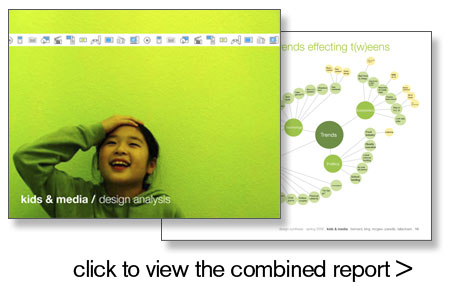
A core of the Institute of Design's education, and what in my opinion differentiates itself from all other institutions, is the work and classes taught by Vijay Kumar. Vijay's understanding and work on the process of creating breakthrough innovations at not only the product but also the system and platform level is unmatched.
The file for download is a combination of the work from two of Vijay's classes: Analysis (framing of insights) and Synthesis (concept generation and system building) taken in Spring of 2006. As these classes were focused on the practice of methods rather than deep execution, the results are thin but broad. That said, the document is great fodder for thought and represents a range of methods found in Vijay's Innovation Toolkit. Download the combined report here: Kids & Media. The following year, I co-taught these classes with Vijay and ID colleague David McGaw.
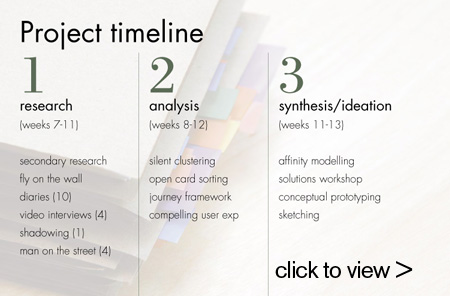
Whole Foods Market /
I did a group project at the Institute of Design in the Fall of 2005 which focused on finding new business opportunities for Whole Foods Market through user and market observation. My team discovered a wealth of insights related to health and leveraging Whole Foods' brand. While the project was focused on finding broad opportunities, our team designed a suite of specific solutions to support unmet consumer needs.
View an abridged version of our full presentation with only one design imperative and one solution illustrated here: download. This file requires Adobe Acrobat 6 or later to view the video clip.
OXO portfolio plan /
Portfolio planning is a key function in companies which, unfortunately, is too many times assumed rather than specfically practiced. Strategy is about making decisions about what will and won't get made rather than making everything or following a competitor.
Matt Mayfield, a veteran Motorola portfolio and product planner and now a full-time faculty at the Institute of Design, taught this planning class in Fall of 2005. Individuals were assigned a client and instructed to evaluate its current portfolio to drive recommendations about strategy and future product development. Download my take on OXO's portfolio circa 2005 here.

Yahoo! User Experience /
I spent the Summer of 2005 working on a series of projects with fellow ID colleague Erik Almenberg for famed innovator and the inventor of "cut and paste", Mr. Larry Tesler. While the content of our work is top secret, we can say we helped the leaders of the Yahoo! User Experience Design group evaluate the company's development process, making recommendations to increase the hit rate of innovation. In addition, we authored a case study on best practices at Yahoo! as well as developing a product and portfoliio planning project approach for Yahoo!'s Mobile group. Erik ended up accepting a position at Yahoo! as a Design Strategist although has since moved on to Motorola and now Doberman in Stockholm.
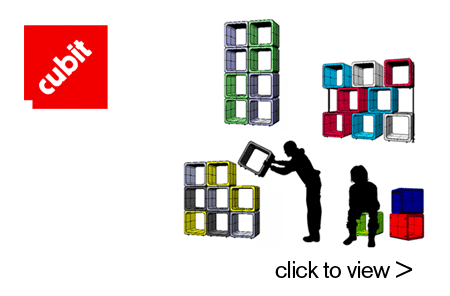
cubit /
While I am focused on strategy and management but I couldn't resist designing something for Designboom's Teenage Furniture competition back in early 2005. Picked from 3551 submissions as one of the few “coolest ideas”, cubit is a fun, flexible and practical take on storage. Made of matte textured abs plastic and designed to be easily produced in many colors at relatively low cost, cubit allows individual expression through arrangement and color choice. One unit could act as a night table, tv/gaming stand, tool, or in various configurations as a wall-unit. The concept could be extended to include other sizes, shapes and specialized units and meets the needs of teens, manufacturer and furniture company.
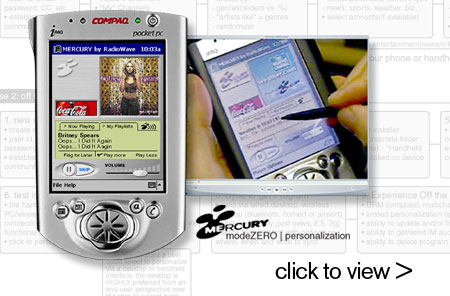
Mercury portable media /
The Mercury portable media prototype was built to demonstrate a hybrid model of online, offline and user-selected interactive multimedia content experiences expected with forthcoming handheld and fastband (3G/4G) wireless devices. Representing a forward thinking approach to portable music, Mercury's functionality was similar to the iPhone/iPod of today and was built fully one year in advance of the original iPod's introduction. The device actually received wirelessly delivered news content produced by Radiowave and inserted it dynamically mid-program per user preferences. View a movie of Gary Brandt, RadioWave's head of platform engineering, demonstrating Mercury here.
I lead the design and development, executing secondary market research and working with C-level management to author functional and creative product requirements.
RollingStone Radio /
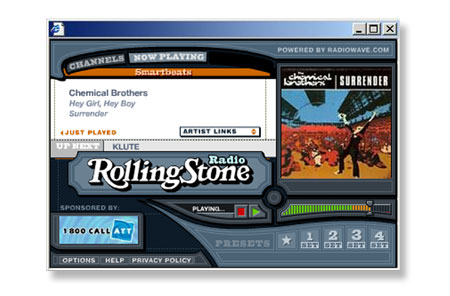
In working as Product Manager and Experience Lead way back in 2000 for RollingStone Radio, I managed all aspects of the development of the interactive media player. Responsibilites included the writing of all business, functional and design requirements, as well as setting project timeline, budget and client communications.
With this development we created the platform on which all of RadioWave's branded and terrestrial radio were based. Forty+ entertainment channels and ad services were accessed by over 2 million users per month.